Traditionally, when people talk about teas, they usually mean herbal infusions or drinks made from raw material sourced from Chinese tea plantations—and at most, a wider variety of Indian, Japanese, or other world teas. Yet tea can sometimes be highly specialized, with plant material that grows only in an endemic region. One such unique and authentically local beverage is honeybush tea. The honeybush plant grows naturally only in a narrow stretch of South Africa, and this plant’s tea is often compared to the well-known red rooibos tea. Let’s explore honeybush tea benefits, geographic impact, and how to prepare it.
What Is the Plant a Honeybush?
Honeybush refers to a group of shrubs from the Cyclopia genus, native to South Africa. The teas made from these plants carry gentle honey-like notes, which is how they earned their common name. In fact, several species of honeybush exist, and multiple ones are used for tea, such as Cyclopia intermedia, Cyclopia subternata, Cyclopia genistoides, and others. These shrubs are a source of regional pride, as they are endemic and do not grow anywhere else in the world. Although some species have become vulnerable or even near extinction, widely used varieties are cultivated commercially, so shortages are unlikely anytime soon.
Belonging to the legume family (Fabaceae), honeybush plants exhibit characteristic features: trifoliate, narrow leaves along the stems; bright yellow, sweet-smelling, irregularly shaped flowers; and small pod-like fruits. The shrubs are not tall—most species reach only 1–2 meters, with the tallest growing up to around 3 meters.

What Is Honeybush Tea Like?
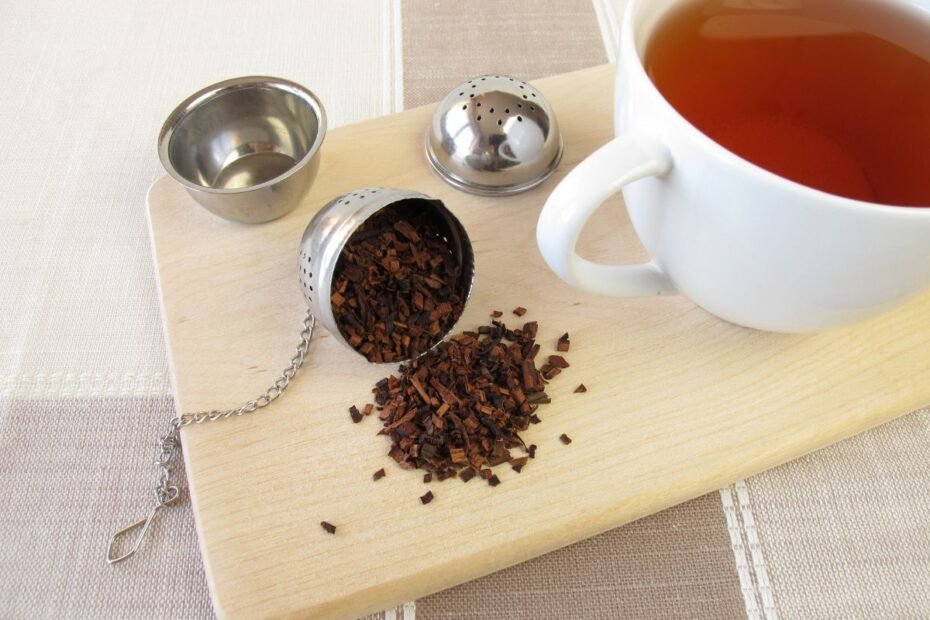
At first glance, honeybush tea matches the rooibos, yet its flavor profile is distinct. The dried plant material often resembles a mixture of bark and small wood chips. The tea consists of dried stems, leaves, and flowers, creating a blend of light and dark brown particles.
While closely related to rooibos, honeybush tea is gentler and naturally sweeter, marked by soft honey notes. Its taste evokes honey, caramel, vanilla, and peach, with some Cyclopia species offering subtle floral or citrus undertones. Its aroma also carries honey accents, complemented by mild floral and vanilla warmth. Compared to rooibos, honeybush is less “herbal” and entirely free from bitterness or astringency.
Honeybush tea is available in both unfermented and fermented forms. Fermentation produces a range of colors—from golden yellow and amber to coppery red-brown.

What Gives The Values to The Benefits of Honeybush Tea?
The tea’s color, aroma, flavor, and beneficial properties come from the bioactive compounds released during brewing. Researchers have identified numerous antioxidant, polyphenolic, and flavonoid compounds, including mangiferin, isomangiferin, hesperidin, isookuranetin, luteolin, orientin, and various phenylpropanoids (such as coumarates and ferulates). Small amounts of vitamins C and E, as well as minerals like calcium, manganese, potassium, magnesium, zinc, copper, and iron, are also present. Collectively, these substances exhibit anti-inflammatory, antidiabetic, and neuroprotective properties and are being actively studied in other fields.
It is also worth noting what honeybush does not contain: caffeine and tannins. While both of these compounds have their uses, people who avoid caffeine or dislike tannin-related bitterness may find honeybush a highly appealing option.
Honeybush Tea Benefits
Thanks to its unique biologically active compounds, honeybush tea benefits are associated with several potential advantages:
- Antioxidant activity. Numerous in vitro and in vivo studies indicate that Cyclopia extracts have strong antioxidant effects, helping reduce free-radical activity and oxidative stress.
- Antidiabetic potential. Studies on diabetic mice and rats, as well as in vitro models, suggest that honeybush extracts may help lower blood glucose levels, enhance antioxidant protection in pancreatic tissue, and inhibit carbohydrate-digesting enzymes. However, human clinical data remain limited.
- Anti-inflammatory and skin-protective effects. Research shows that both fermented and unfermented honeybush tea may reduce UVB-induced skin inflammation, lower COX-2 expression, and exhibit anti-wrinkle potential in animal models and skin cultures—hence its growing use in cosmetics.
- Bone metabolism support. Laboratory and experimental studies on commercial honeybush extracts have shown reduced osteoclast formation and decreased bone resorption.
- Mitochondrial and neuroprotective effects. Some in vitro research suggests that honeybush extracts may help preserve mitochondrial function following oxidative stress and mutations. It points to potential relevance in aging and neurological studies.

How to Prepare Honeybush Tea?
Honeybush tea is easy to find in many countries—all major grocery stores and specialty shops typically carry it as loose herbal tea.
If you want to ensure authenticity, check the label for the species name (Cyclopia or honeybush) and South African origin. Many producers also hold authenticity or quality certificates. Fortunately, honeybush is rarely counterfeited—unlike matcha, Darjeeling, or several other teas.
To prepare the tea, add one teaspoon of the herbal blend to a 250 ml cup and pour over freshly boiled water. Let steep for 5–7 minutes. Steeping for up to 10 minutes is also fine if you want to extract more antioxidants; the tea will not turn bitter due to its low tannin content. You may drink it plain or with milk and a sweetener. Honeybush is caffeine-free, making it a pleasant bedtime drink.
Possible Side Effects
Honeybush tea is very gentle, and reports of adverse reactions are rare. It is often considered a suitable alternative to rooibos during pregnancy or for children, though research remains limited. Experts typically list only a few theoretical risks:
- Allergic reactions such as rash, itching, or stomach cramps.
- Potential interactions with medications. Some compounds may influence liver enzymes (specifically CYP450), potentially altering the metabolism of certain drugs.
- Slight blood sugar reduction. Animal studies show glucose-lowering effects, so individuals sensitive to such changes should monitor their health.
- Occasional mild bloating or nausea.
- Because clinical data with pregnant or breastfeeding individuals and children are still insufficient, experts recommend consuming the tea in moderation (one cup per day).
Sources:
- https://www.healthline.com/nutrition/honeybush-tea
- https://www.webmd.com/diet/health-benefits-honeybush-tea
- https://www.researchgate.net/publication/273083376_Fact_Sheet_on_Honeybush_Tea
- https://onlinelibrary.wiley.com/doi/abs/10.1111/jfbc.13478
Associative photos © Canva.